







The Method Cards for Movement-based Interaction Design (MeCaMInD) project is an ambitious initiative funded by the EU through the Erasmus+ strategic partnership program. Our primary objective is to introduce movement as an integral component in the design process of new practices, artifacts, and interaction designs for sports and physical activities. The intent is to drive the development of more sustainable movement technologies and sports concepts, enhancing health and well-being for people across Europe.
MeCaMInD is a cooperative endeavour involving six prestigious institutions: the University of Southern Denmark, Aalto University, Malmö University, Universidad Carlos III de Madrid, the University of Twente, and Uppsala University. We are committed to creating and enhancing a movement-based creative design environment. The project caters to students and design professionals, providing an array of tools and methods.
The movement-focused design approach aims to rethink how technology can be integrated more naturally and engagingly into our daily lives and activities. MeCaMInD envisions a future where technology, sports, and movement fuse seamlessly to promote an active, healthy, and joyful lifestyle.


At MeCaMInD, we believe in placing human movement at the forefront of design, whether it's wearable technology, home appliances, sports tools, or physical training aids. Our philosophy is that the body is not just a vessel for interaction, but a source of creativity and innovation in its own right. By engaging the body as a source of creativity, we can enrich our interactions with technology, promoting physical activity, health, joy, and enhancing the naturalness of these interactions.
We don't view movement merely as an added feature, but as the core around which the entire design process revolves. By sensitising designers to the nuances of human movement, we aim to foster a deeper understanding of the role of physicality in our interactions with technology. This approach is essential in creating design solutions that are more responsive, intuitive, and ultimately beneficial to users.
The application of our approach leads to unique design possibilities. By centring on the intricacies of human movement, we are compelled to invent solutions that harmonise with the body's natural rhythms and capabilities. This perspective pushes us beyond traditional design boundaries, inspiring designs that not only satisfy practical needs but also enhance the holistic experience of movement. Through our work, we are not only advancing the design of individual products, but also redefining the possibilities of movement-inspired design itself.
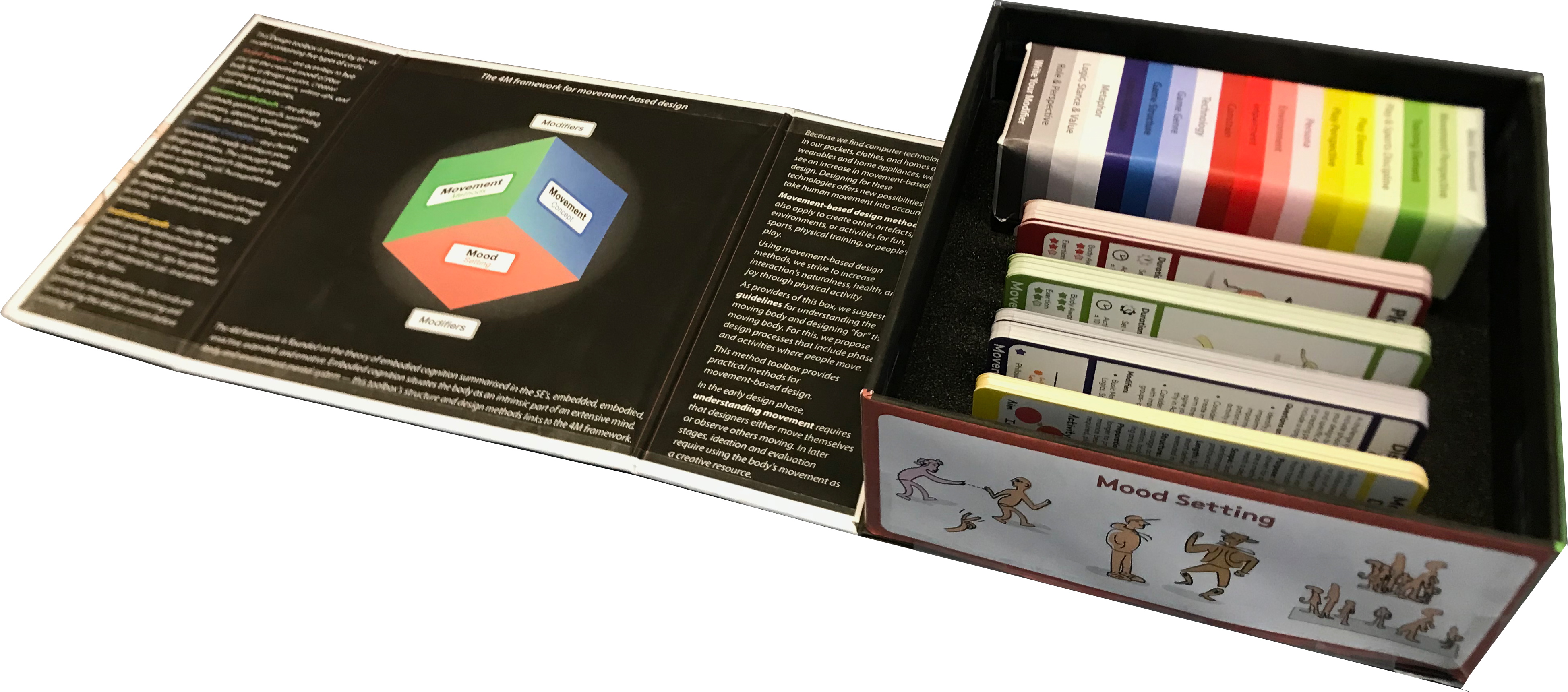
To bridge the challenging breadth of the combined fields of design, sports & movement, and technology, we have developed an accessible and well-rounded toolbox of embodied design methods. This toolbox, a collection of Design Method Cards, provides a user-friendly approach to guide design activities. Each card details the method's goal, procedure, use contexts, constraints, and variations. They also feature visual aids such as videos, pictures, and graphics for better understanding.
The method cards are categorised into five types:
- Mood Setters: Activities to set the creative mood for a design session, including icebreakers, warm-ups, and team-building activities.
- Movement Methods: Design methods for sensitising designers, ideating, evaluating/polishing, or documenting solutions.
- Movement Concepts: Chunks of knowledge from various fields to inform your design solutions.
- Modifiers: Cards to tweak the current design activity or find new perspectives and solutions.
- Instruction Cards: Detailed instructions for the various cards, facilitation guidelines, suggestions for music, physical props, and sketched design flows.
The method cards will be available in a method card toolbox and via our web service. We will provide sorting functions for planning design activities based on various factors like the time required, the embodied focus of the method, number of participants, and preparation efforts. Furthermore, we will provide guidance for facilitation and instructional videos.

The MeCaMInD project aspires to build an interdisciplinary network across Europe, embedding movement as a vital component of the design process. This goal extends beyond merely inventing new design products. Instead, we seek to cultivate a new design mindset where movement is integral to creativity. We foresee this innovative approach influencing future technologies, sports concepts, and movement practices, ushering a new era for designers, engineers, and students.
We believe in the power of our movement-based methods to promote well-being and a healthy lifestyle. We envisage designers and engineers creating products and environments that inspire physical activity, bringing joy through movement. Our students are the future ambassadors for this movement-centric philosophy, set to make a lasting impact on society.
The MeCaMInD project represents more than just a convergence of design and sport - it is a catalyst for societal transformation. We aim to inspire educators, policymakers, and citizens to see the value of integrating movement in all facets of life. Our vision extends to how we work, play, and interact, fostering an environment where natural and engaging movement is seamlessly woven into our daily activities. The potential societal impact of this shift is profound, influencing not only individual well-being but also community health, public spaces, and cultural norms. Through MeCaMInD, we are taking an ambitious step towards a more active, health-focused, and movement-centred future.
The MeCaMInD Method Cards were developed to simplify the design process and make it easier to include motion in sport, movement, and technology design. The development of the MeCaMInD method cards is the result of an interdisciplinary collaboration drawing on expertise from engineering, interaction design, and sports sciences, all of whom bring in-depth insights into designing for and with the body. This diverse knowledge base has informed the creation of a toolbox that supports sustainable movement technologies and sports concepts. Each method card is the product of this collaborative and diverse perspective, incorporating insights from these varied fields. Based on these insights, each card succinctly describes a method's goal, procedure, context of use, and potential variations. The result is a comprehensive and user-friendly resource that can assist in the creation and refinement of design solutions across numerous contexts.
Our method cards have been rigorously tested in a wide array of fields, including sports performance enhancement, health treatment, workplace physical activity, inclusive sport, mental health in sports, PE-teacher education, creative technology development, high school sports innovation camps, exergames, and more. This extensive and diverse testing process ensures that our cards can be effectively applied across different contexts, enriching the design process with an understanding of human movement.
The method cards, along with their instructions and guidelines, will be disseminated through various means: the method card toolbox, the project's website, Mood Setting instruction videos, and graphics to support the text descriptions. They are organised according to the 4M framework, founded on embodied cognition principles. The instructions also provide examples of design route maps – or "design flows" – to help users plan design activities like workshops and events. With these method cards, we aim to spark movement creativity, yielding fruitful outcomes in a variety of contexts.


Our team brings together experts from the domains of sport and movement sciences and interaction design. The team includes:
SDU
- Lars Elbæk
- Maximus Kaos
- Rasmus Vestergaard Andersen
- Søren Lekbo
- René Engelhardt Hansen
- Lærke Schjødt Rasmussen
UT
- Dennis Reidsma
- Robby van Delden
- Dees Postma
- Anne van den Biggelaar
UC3M
- Elena Márquez Segura
- Ana Tajadura-Jimenez
- Laia Turmo Vidal
UU
- Annika Waern
- Maria Normark
MAU
- José María Font Fernández
- Mats Johnsson
AU
- Perttu Hämäläinen
- Solip Park
Their shared expertise and collaborative spirit are the driving forces behind the MeCaMInD project, contributing to the innovation and impact of the method cards.
Graphic design and illustrations are handled skillfully by Mikkel Larris from SDU.